





Earthquake and the Collapse of China’s Economy 2022
In a country like China, which was supposed to be run based on socialist and communist principles and has now turned into a state-driven capitalist structure, it was natural that for years the idea of citizens owning homes based on construction and transactions in the private sector had no meaning. The transformation that took place after the early years of reforms in China was comprehensive, and one of its aspects was this very housing sector and its relationship with the emerging private sector.
The first steps were taken by the Communist Party during the reforms by encouraging government employees to become homeowners through the newly created and expanding private sector. Over the years, the construction industry gradually reached a point where it is now one of the main pillars of the American economy. If we consider the developments of the past year, this pillar is very shaky.
The construction industry is almost everything.
The revenue of China’s construction industry in 2020, as a benchmark for a normal economy before the Corona era, was 17 trillion yuan. There is no rival for such an industry in the investment market leading to production. Various Chinese companies, as pioneers in attracting investment for housing production and pre-selling major projects globally, gained historical fame.
Among these companies, Evergrande was the most famous and wealthy. This giant of the global construction industry, which went through a round of bankruptcy this year, was the highlight of construction industry news in China and the world. In ideal conditions, this company had nearly 600 million square meters of land and housing. The crisis of inability to pay dividends and various installments by this company in late 2021 and early 2022 indicated the peak of the construction industry crisis.
For the Chinese, if the construction industry is not everything, it is the most important factor of capital and income for significant parts of this country. For Chinese citizens, in a situation where the transition from a socialist-communist economy has occurred and state capitalism has been established, it is the most important field for investment.
Pre-purchasing construction projects is one of the few ways for Chinese people to invest seriously outside this country, which is almost impossible due to various monopolies created by the communist government. For regional governments, construction companies, and real estate transactions, the revenues from registering the sale of national land to companies for skyscraper construction and all revenue matters are the lifeblood of their budgets. A significant portion of China’s regional governments’ budgets, and in some cases far beyond that, is supplied by this sector.

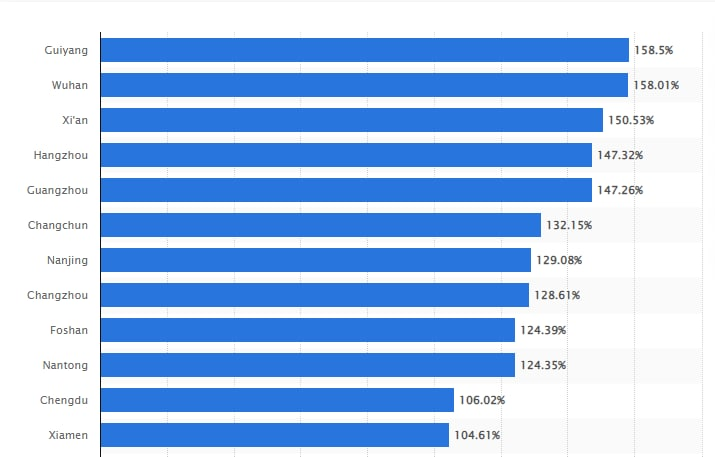
The crisis arrived.
The Corona crisis was the beginning of the downfall of various sectors, and in this situation, given the serious economic and social crisis in China under the complete and definite lockdown of cities, citizens, and society, housing companies faced increasingly more problems. Long before the Corona crisis, for several years, the crisis of numerous built and empty skyscrapers and malls was one of the well-known stories about China. After the Corona era, another crisis arrived.
Companies’ revenues decreased, and their ability to complete projects they had pre-sold long ago diminished more and more. In December 2021, Evergrande recorded its first round of inability to pay dividends and installments, and alarm bells rang until it ultimately officially entered a state of limited bankruptcy.
Evergrande faced financial responsibilities worth $400 billion. The mentioned period until the official announcement of Evergrande’s limited bankruptcy was a time when economists, market experts, and researchers on Chinese issues focused on the Chinese construction industry. What received less attention was the discussion about Chinese citizens who had purchased pre-sold and incomplete construction projects.
Quasi-Civil Resistance
China is experiencing various economic problems, big and small, after the Corona era. The policy of complete and definite city lockdowns, especially in a city like Shanghai, put a lot of social pressure on people. No expert expects widespread public and civil protests in China; however, some protests regarding financial problems that incapacitated small banks and troubled people were held by the public, which were very limited.
The special civil protest related to construction, however, is something else. About two months ago, 900 Chinese people in one of the country’s cities protested the non-completion and delivery of their pre-purchased project by refusing to pay installments to Evergrande, and this was just the beginning. Cases of installment non-payment increased day by day, and it reached a point where construction companies, caught in the anger of customers, contacted banks and announced that their institutional and corporate monthly payments should be stopped.
Since people will not pay installments and no money will be deposited into their accounts, this is a crisis for the banks themselves. Housing installments are one of the best sources of income and financial circulation for Chinese banks, and naturally, they have become dizzy with this quasi-civil resistance by the people in paying installments. It reached a point where central and regional government officials took action and, while taking some steps, encouraged banks to help construction companies complete their projects through financial cooperation. The value of citizen installments in the construction industry for unfinished projects is estimated to be at least $220 billion.

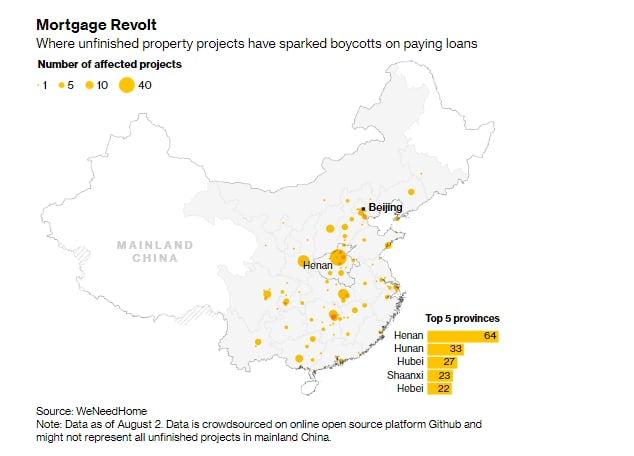
China’s economy is facing a serious decline in growth, and the best estimate in the current situation is registering only a 3% growth in 2022, which would be a dream. Various crises in the capital sectors, especially the construction industry, and other problems have led the People’s Bank of China to recently seriously reduce interest rates. The construction industry alone accounts for one-third of China’s economy, and the crises in this sector continue to shake and bring down the Chinese economy.
