
Attack on Consensus and Agreement
Attack on consensus and agreement, the issue of internal consensus and external de-escalation has been on Masoud Pezeshkian’s agenda since the elections.
Now it seems that the Stability Front team intends to disrupt the equations as much as possible.
In the first step with what is happening in the parliament and in the second step in the path of the foreign policy of the fourteenth government, which ideally ends in another agreement.
Araghchi’s Narrative on JCPOA and Trump
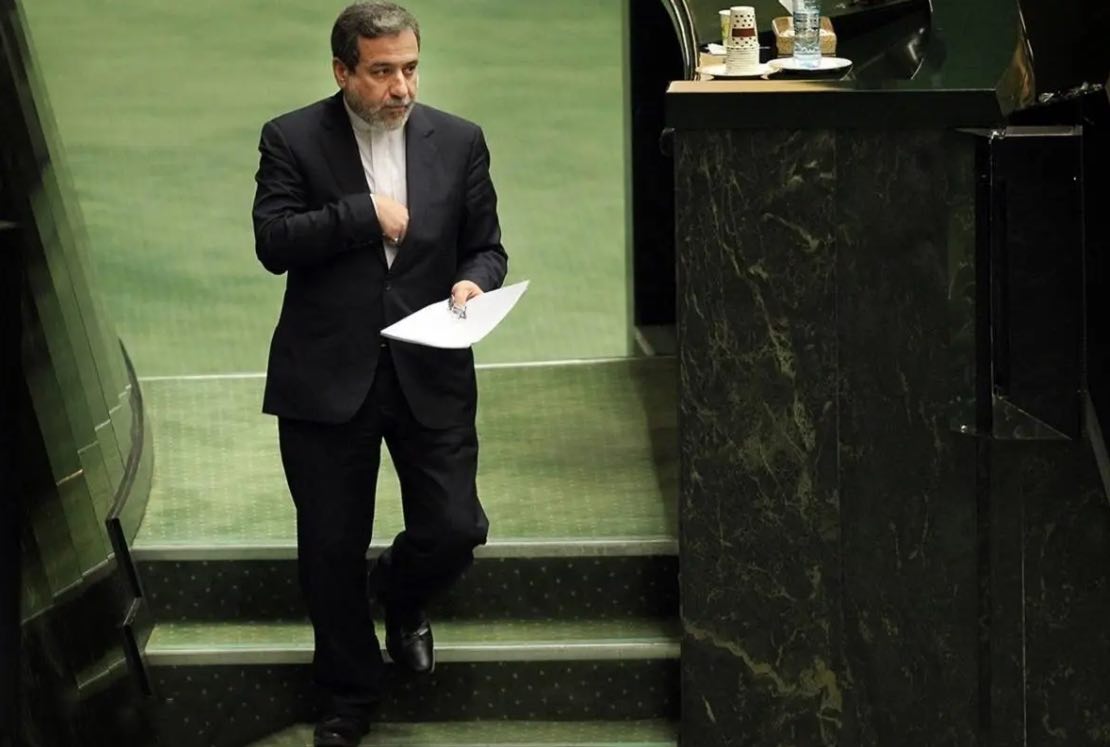
Seyed Abbas Araghchi is an experienced diplomat with a history of working at senior levels in the foreign ministry across different governments and time periods.
He spoke candidly both in the commission and on the parliament floor.
He talked about maintaining Iran’s strategic balance, the foreign ministry’s entry into the wealth production circuit, resistance diplomacy, border regions diplomacy, and the active engagement of the fourteenth government’s diplomatic apparatus.
In response to Amirhossein Saeedi, the former host of Ofogh network and the current representative of Tehran, who was his most prominent opponent and broadcasted a video of his remarks about the JCPOA and Trump, he said: This video shown of me was very surprising because it is a testament to my pride. In the last sentence I used in this video, I said that Trump cannot destroy the JCPOA, and I did not say that Trump would not leave the JCPOA, and that is exactly what happened. When the US left the JCPOA, they tried twice and took it to the Security Council to destroy the JCPOA, but both times they failed. It was unprecedented for the US to take a resolution to the Security Council and be defeated with 13 votes against and 2 votes in favor, and this happened twice.
Therefore, negotiation to lift sanctions in any form has been the policy of the Islamic Republic of Iran and continued in the martyr Raisi’s government.
Elsewhere, he referred to a tweet by Saeedi that has recently gone viral, in which he wrote, ‘Death to the border and criterion that recognizes me as familiar because I was born in a land where Araghchi, Zarif, Rouhani, and Bani Sadr were born, but considers the Fatemiyoun fighters strangers because they were born a few kilometers away.’ He also said: Mr. Saeedi, I do not say death to a homeland where my compatriot Araghchi is, but I say my life for a homeland that allows a critic of the government to speak without stuttering and even question the parliament’s allegiance. I respect all my critics.
The issue of reviving the JCPOA in the final years of Rouhani’s government and the continuation of this path in Seyed Ebrahim Raisi’s government was also among the important issues he raised. Araghchi said: When I designed the negotiations to revive the JCPOA in April 2021, it was within the framework of the system’s definitive positions and considering the strategic action law. I showed my opinion and practical commitment not now, but in April 2021, to the strategic action law. The JCPOA revival negotiations, six rounds of which I conducted, were within the framework of the strategic action law and the system’s definitive positions. In the second round of those negotiations, the leader addressed me and the negotiating team in a public speech, saying, ‘Say Hasbunallah and move forward.’
Attack on Consensus and Agreement
In yesterday’s parliament session, there were several interesting points.
First, Araghchi’s emphasis on the leader’s support for efforts to lift sanctions within the framework and a reminder that the proposed foreign minister had previously designed the revival negotiations within the strategic law framework.
Araghchi confirmed that the leader does not oppose an agreement that secures the country’s interests and untangles people’s lives.
The second was the statements made by Saeedi, the opposing representative to Araghchi.
He said some of Araghchi’s supporters say you must vote for him because someone said he should be voted in.
It is unclear whether the pronoun’s reference in this hardline Tehran representative’s remarks refers to the leader, Mohammad Bagher Ghalibaf, or any other politician.
If the pronoun’s reference is Ghalibaf, it points to Pezeshkian and the parliament speaker’s agreement to gain a vote of confidence; otherwise, what some observers and analysts noted was that the foreign minister is introduced to the parliament with the leader’s approval and agreement. However, Ayatollah Khamenei has never commented on voting or not voting for a candidate related to political and security ministries under his supervision. But this interesting remark by the representative close to the Stability Front was noted.
Mohammad Mohajeri, a principled political analyst, wrote on his Twitter that it was said that the Stability Front members and Saeed Jalili’s gang would stand against the leader. This is not an analysis; it is news.
For now, they send their underlings and children to the field under the pretext of attacking Abbas Araghchi and the JCPOA so that their leaders suffer less damage. Later, when they officially enter the war like the Kharijites, the game will be spectacular.
The next issue is that the Stability Front generally questions the principle of negotiation and agreement, while the leader may have said at some point, ‘There will be no war, we will not negotiate’ in 2019, but in the end, Seyed Ebrahim Raisi’s government initiated secret negotiations with the US in Oman.
Therefore, avoiding negotiation and agreement has never been proposed as a permanent strategy.
We must see what this current will do with the proposed foreign minister in the coming days and, in the first step, what obstacles it will place in the path of the fourteenth government’s foreign policy.
No agreement in the world is flawless.
Javid Ghorbanoghli, a former ambassador and foreign policy analyst, said about the remarks made in yesterday’s parliament session that the session’s issue should be viewed from two angles. One angle is Mr. Araghchi himself, who has been and is the right-hand man of Mr. Zarif in achieving the JCPOA and the entire path leading to it. The other angle is the principle of the JCPOA.
The JCPOA was the result of a great diplomacy that the system decided on and was carried out with the leader’s decision. The leader supported it, and the work reached a result. It was not a personal decision by Rouhani, Araghchi, or others; it was approved with support.
If we want to talk about the principle of the JCPOA, this very JCPOA has supporters and opponents. Supporters say the JCPOA is not flawless because, fundamentally, in the world of diplomacy, no agreement is flawless. An agreement is a compromise that both parties reach.
The parties, as a result of long-term diplomacy, present their demands and desires to ultimately reach a point of balance.
He continued: Let’s not forget that before the JCPOA, we were under UN Security Council sanctions. Supporters and defenders of the agreement say it is not that before the nuclear negotiations and agreement, the country’s situation was global.
We were compelled to agree, and this work also started in the last year of Mr. Ahmadinejad’s government, when Mr. Salehi went to Oman and negotiated.
This former diplomat stated that the opposing group to the agreement are those I consider the same worried ones during the negotiations and agreement. During the negotiations, they resorted to all sorts of methods to prevent the JCPOA from being signed.
From climbing the embassy walls to publishing night letters and other actions, they have also gained power over these past few years.
In my opinion, these two perspectives must be managed to ultimately reach a result.
Ghorbanoghli, pointing to the importance of keeping Iran away from UN Security Council sanctions, noted: I think Mr. Araghchi intends to continue this path until October 2025 arrives, Resolution 2231 expires, and conditions in the Security Council fully return to normal.
From this time, the previous six resolutions cannot return unless the other party uses the snapback mechanism, which has its own requirements. In those conditions, Iran’s nuclear program also remains in place. Currently, we are at a dangerous and difficult turn that we must be able to pass safely.
The former Iranian ambassador to South Africa recalled that we need an agreement, whether it’s called the JCPOA or not. The nuclear agreement is one of the necessities for pursuing Mr. Pezeshkian’s policies. Those who oppose this issue are, in fact, blowing on the fire that Netanyahu has lit.
The nuclear agreement currently does not have a good situation, and the Israeli prime minister wishes for the return of Iran’s sanction resolutions in the Security Council.
Without lifting the sanctions, even with Pakistan, it is not possible to work.
Mehdi Zakerian, a professor of international relations, said about these positions: It is clear that Iran needs to lift financial, economic, and political sanctions to connect to the global economy and international markets. Until the sanctions are lifted, Iran’s economic progress is not possible.
Such an issue requires an international agreement. You can’t hold a fish and say in the market, ‘Give me a duck in exchange for this.’ Iran is a raw material seller and does not have specific industrial production.
Cars, textiles, toys, or anything we can consider a consumer good, for this reason, our country is not an effective producer in the international system. Therefore, this very issue is a limitation.
But even if we were, we would still need a connection with international financial networks to connect with the world. This connection has been lost, and to be able to sell something, we pay more and call it the gray market, a market that is detrimental to Iran.
Therefore, we in Iran need an agreement, whether it’s called the JCPOA or not. These statements that were made are political posturing and do not solve any problem for the country.
He added: This very current raised the issue of barter, giving oil in exchange for junk goods, not industrial and capital goods. They claim that this method is effective. Let them provide a report to see what achievements we have had in the past three years and Mr. Raisi’s government with this method.
We took taxis from China, the amount of that contract is equivalent to China’s investment in Iran’s neighboring countries.
We have not gained anything. They should say your JCPOA is worthless, we obtained these with our own method. The same JCPOA they say had no value opened many doors for Iran. After Trump’s exit, we did not pursue reviving the JCPOA, we said we would work with Europe, the Russians, and the Chinese.
The US also blew up the entire agreement.
Internally, they also obstructed. Under these conditions, it is not possible to work. We want to work with neighboring countries. Saudi Arabia works with us. Does Pakistan’s central bank allow financial interaction with us? Can we barter with Pakistan, give oil, and what do we get?
Zakerian added: Talking is easy. Sometimes when representatives speak, it feels like they have taken an elevator to the top and have not achieved anything with effort.
Because these words do not seem to have a scent of understanding the difficult living conditions of the people. Someone who has lived like the people understands these issues.