

Protests by the Chinese People Bring China to a Standstill
In recent weeks, the days have been marked by the public display of anger by the Chinese people towards the policies of the ruling Communist Party of China. The important point about these protests is that what we know about them, along with the images, videos, and reports transmitted, undoubtedly represent part of the reality of the protests that have occurred in various cities across China over the past two weeks.
Heavy news censorship and control of social networks in China have made it impossible for many events to be reported and made public. Whatever has emerged from the various dimensions of the protests and public anger towards the policies of the Chinese Communist Party, the central authorities in Beijing, and regional officials in the international arena have sparked slight hopes among human rights activists and freedom seekers.
Protest and Expression of Dissatisfaction
For many political and social experts on China in the West and researchers following the developments in this country, two points had almost become self-evident. One was that the Chinese citizen identity had become largely alienated from the concept of expressing anger and dissatisfaction and showing protest against the current situation. The other was that in recent years, the grounds for dissatisfaction have seriously existed, and the Chinese people have had serious reasons to criticize their situation.
Everything did not start with the outbreak of the Corona crisis and the beginning of the astonishing and historical spread of this deadly virus from China to the rest of the world. However, this story must be considered a turning point in China’s modern history. The astonishing scenes that Western journalists transmitted in the early hours about the complete lockdown of Wuhan and the efforts of Chinese citizens to flee this area were the moments when the first heavy shocks hit Chinese society.
Large cities with citizens who had long been accustomed to modern urban life, albeit according to the version of the Chinese Communist Party, were imprisoned by the administrative and political authorities of the cities and various regions in their apartment cages. During the international Corona crisis years, the concept of lockdown and the complete closure of cities, all offices, buildings, businesses, travel, and other collective domains became familiar to citizens of many countries around the world. However, the Chinese version of the lockdown was a strange one.
The deadly silence of the streets in the West during the Corona shutdown days was experienced by the Chinese in the corridors of residential complexes. The closure and restriction started from the doors of homes and apartments. Reports about protests against these conditions existed, yet there was never any sign of widespread protests. The main reason for the success of the ruling Communist Party officials should be sought in the development of a powerful social control structure. This point is more important than the Corona story in recent years.
The Concept of Chinese Social Control
The ruling Communist Party of China should be considered one of the most powerful governing bodies in terms of social control and the development of software and hardware structures, as well as the training of official and unofficial security and police forces for citizen surveillance and monitoring. The administrative and political structures for citizen surveillance in China are designed in such a way as to provide high capability for controlling any unpleasant events.
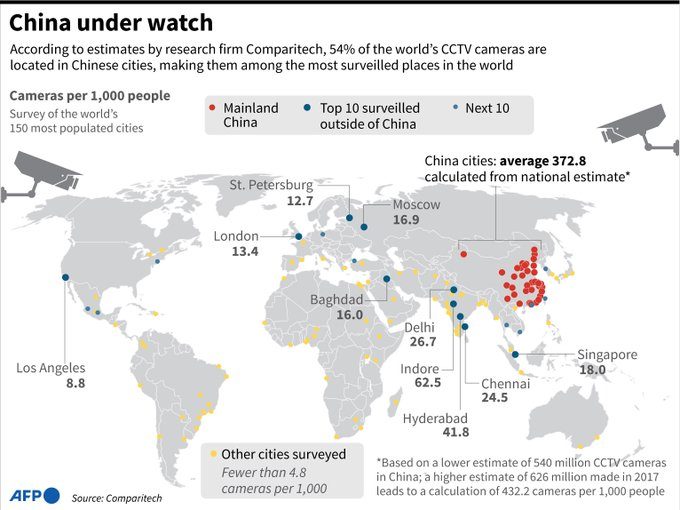
These administrative and political structures are equipped with the latest technologies needed to monitor urban structures, public places, various social facilities and institutions such as schools and universities, hospitals and medical centers, various recreational centers from cinemas and parks to even tourist centers, public transportation structures, and large urban residential centers.
CCTV cameras are one of the fundamental and inseparable aspects of Chinese citizen life. More than trash bins, CCTV cameras can be found on the main streets of Chinese cities. The urban life has also expanded, and a significant part of China’s population has become urbanized, living under the shadow of CCTV cameras.
The Chinese have effectively expanded modern technologies and ultra-modern hardware for these cameras and have become one of the major exporters of technology and equipment in this field. Unfortunately, the Iranian regime is also one of the key customers of Chinese companies involved in the production of cameras and other urban control equipment.
Public Protest is Abundant in China
Contrary to the belief of many, public protests and the expression of dissatisfaction do occur in China. In fact, public gatherings in protest against disorders are relatively common, and these protests actually focus on various issues and are directed at regional and local administrative and political officials, often accompanied by slogans, statements, and phrases based on expressing dissatisfaction.
Farmers and industrialists have raised their protests on various issues, which is somewhat similar to the specific gatherings of various labor unions in Iran, where instead of protesting, they pledge allegiance to the regime by carrying flags and pictures of the leadership and president.
An interesting point in this context is the emergence of several protest movements by the middle and upper-middle classes, which have differed from other social movements in China. The most important example of seemingly simple yet significant social movements, which we have previously reported on regarding China, is the public anger of real estate investors in China. The disorder in the construction industry and the problems of the largest construction companies in China, and indeed the world, have put their capital, hope, and lives at risk.
A public movement emerged among the middle-class investors in the housing sector to stop paying installments in protest against the non-delivery of pre-purchased units. This noteworthy protest by these investors, which actually targeted the already distressed and bankrupt or semi-bankrupt construction companies, had a relative result.
The government injected large amounts through banks into the construction industry, and minor developments were made to expedite the delivery of pre-sold units. As we have stated in previous reports, this matter is not a simple one. The construction industry is the heart of industry and capital in China, and the tremors caused by investor protests were no joke.
A serious transformation in the process of forming an independent social identity and establishing coherent group and social structures in China has been slow. Many of the foundations for forming this group identity have been restrained by nationwide and regional party structures.
On the other hand, social transformation resulting from the expansion of urbanization and the manifestation of urban life structures intertwined with party administrative and political structures in various fields such as education, economy, health, trade, and business has caused Chinese life and society to both have special realities and similarities with other societies and, on the other hand, with the lack of coherent group and institutional structures under the shadow of the Communist Party’s domination, the expectations and anticipations of external observers from this society in showing social movements are not met. In the next section, we will talk about the ongoing protests in China and the process that has led to these days in China, protests targeting an issue that Xi Jinping is not willing to compromise on.
- Weather and Environment in Times of War
- Light and Shadow in China’s Crisis-Ridden Capital Market
- China’s Show of Power to the United States in Africa