
Homeland, Football, and Politics
Just like the match against England, Iran’s loss to the USA this time also brought joy to some people. However, these same people are now accused on social media of being anti-patriotic and foreign-worshipping. In response, a Twitter user wrote that previously, they said patriotism was blasphemy, and at most, they would say it’s love for the homeland. But now, the homeland has become important to them.
Continuing the Dichotomy
Are the people who were happy about Iran’s loss and the USA’s win or took to the streets experiencing an identity crisis, being identity-less and anti-Iran? Is what is interpreted as joy over Iran’s loss to the USA a result of efforts attributed to some media outside Iran? Have separatists succeeded in creating a sense of division and lack of belonging towards Iran among some people?
It seems that the matter is more emotional and spontaneous, stemming from a protest reaction, rather than being about identity and nationality. It is definitely temporary, as people feel anger and sorrow over recent events, believing that the national team also turned its back on its people and was unaware of their grief and anger. What is seen from the people should be evaluated as merely a protest reaction at a point in the national team’s history, not a deeply rooted event. It is an emotion that needs to be understood and recognized, not labeled.
What is observed in the reaction of some people towards the national football team these days is neither strange nor new. In September 2023, Iran defeated Iraq in the Al-Shaab Stadium in Baghdad with goals from Daei and Karimi, while Iraqi Arab spectators were cheering for the Iranian team.
Parvaneh Salahshouri, a reformist former member of parliament, tweeted that the national team’s loss and the joy of some people afterward is the result of dividing society into insiders and outsiders. People, lacking choices, opposed what belonged to the insiders.
On the other hand, the Iranian team was supposed to function for the political structure exactly like the title of Simon Kuper’s book ‘Football Against the Enemy’, translated by Adel Ferdosipour, but it didn’t happen. Part of the power structure and the revolutionary current believed that by symbolizing the American team as a representative of its government, defeating it would mean defeating America.
They had certainly prepared many slogans, programs, and statements in advance to use them both internationally and in facing America and the West, and domestically, especially against the protesters. The whispers heard from some figures within the power structure before the game made it clear that they were waiting to start making political references from a national game after the match.
America Struck Us
It’s true that football and politics have often collided, and football is the most political sport in history, with many books, articles, and reports written about it. However, there is another reality, which is that football, in essence, is just football. Apparently, what happens on the green field, especially the game result, is merely a sporting and technical event, and one should not and cannot expect more from it.
Wins and losses in it are unpredictable, and linking the defeat of the American team to the defeat of the American government or imperialism is merely a mental game unrelated to reality.
Why is it unrealistic and wrong? Because this interpretation is a double-edged sword. When you interpret defeating the American team as striking the mouth of criminal America, you must accept that the opposite situation is also true.
When defeating the American team becomes our victory over America in sports fields or defeating the enemy in one of its fronts, then our team’s defeat by America must also mean the victory of the American government over us.
The National Team and the Accusation of Being in the Middle
Childish interpretations and incorrect analogies, irrelevant and excessive expectations placed on something that is not at the heart of politics but on its periphery, and mistakenly and insistently attaching it to politics harm both politics and what is inherently non-political but has its own function and identity. This is what happened to our national football team.
In this context, the footballers were also turned into figures caught in the middle, who, as one Twitter user put it, lost to themselves, to their people, and to those who had politically invested in them. A team that didn’t know what choice to make and was confused under various pressures. News such as pressure on the footballers’ families, meetings with security figures in Qatar, warnings, and, on the other hand, attacks and expectations from the people.
The result was that the footballers didn’t know their stance with themselves, the people, the game, and the government. In the first game, they didn’t cooperate in singing the national anthem and wore black armbands, but in the second and third games, they were forced to back down.
Iran lost to the USA in the 2022 World Cup, just as it had beaten the USA in the 1998 World Cup. It’s that simple, just as other teams have won or lost to each other many times. The most political sports match in the world, in the end, is just a match.
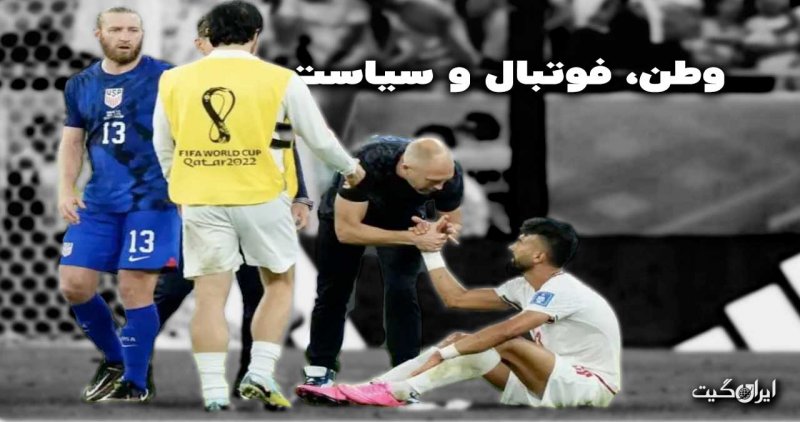
That’s all. At the end of the game and after Iran’s loss, a member of the American team hugged a member of the Iranian team while he was crying. David Benkel, an American sports journalist, wrote about it: ‘If politicians let them, humans will reach out to each other.’
- Qatar, the Desired Host for Censors
- Qatar’s Security Cooperation with Iran to Control Iranian Spectators