
Waiting for Zero Hour
Iran and Israel: The Netanyahu Variable
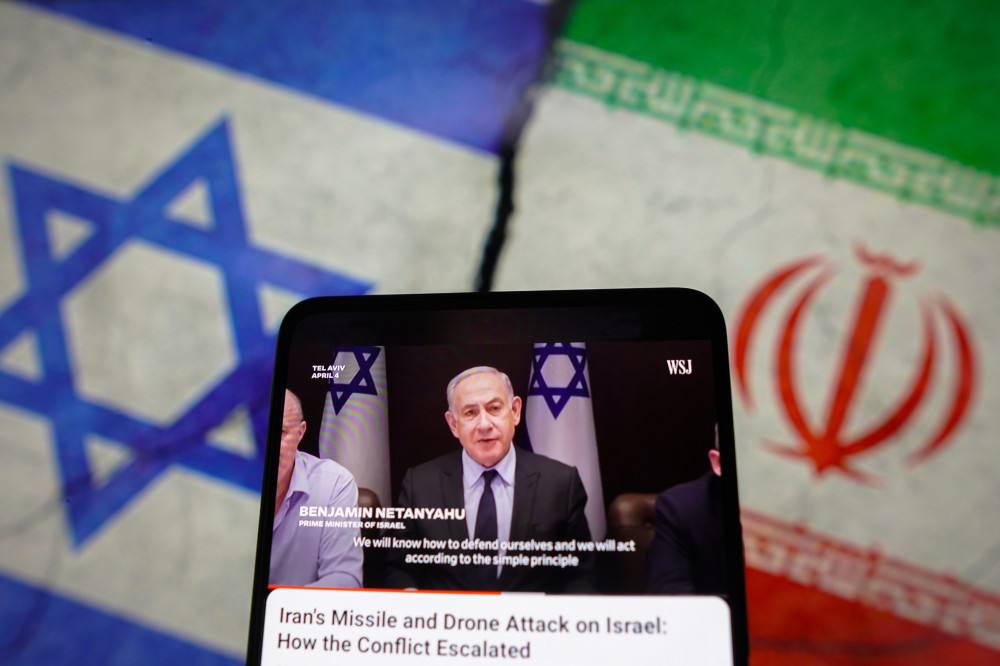
Waiting for Zero Hour after Iran’s attack, Israel’s allies urge the Jewish state to remain calm and aim for de-escalation, but everything depends on an unpredictable variable: Benjamin Netanyahu.
Iran’s attack on Israel on Saturday night garnered support for Tel Aviv from major world leaders, but they immediately urged Israel to exercise restraint. An unusual reaction from Iran reflects the exceptional nature of the operation, which observers and analysts still disagree on.
Iran’s choice to directly attack with missiles and drones from its own territory, without relying on countries closer to Israel like Syria, allowed Tel Aviv to easily intercept and defeat many of Iran’s threats. This seems to indicate that although the attack was inevitable for Tehran, Iran still sought to avoid an all-out confrontation with Israel once again.
Was what Tehran did, in retaliation for the attack on its consulate in Syria on April 1st, a symbolic act to avoid provoking an Israeli response? Will Israel respond further after demonstrating power by intercepting and downing nearly all missiles and drones? Can the crisis be considered over, or is escalation inevitable?
Antonio Guterres, the UN Secretary-General, at an emergency Security Council meeting, urged all parties to step back from the brink and warned that neither the region nor the world can endure another war. A similar request was issued by G7 leaders who condemned Iran’s attack but also clarified that we must avoid escalation.
Despite Benjamin Netanyahu, the Prime Minister of Tel Aviv, and his war cabinet announcing that a response to Iran’s attack in methods and timings chosen by Israel is on the way, Washington emphasized that support for the Jewish state is unconditional. However, the United States will not participate in a retaliatory attack against Tehran. Thus, the message was clear: the United States does not intend to enter another war it did not want from the start.
Now it remains to be seen whether Israel and Prime Minister Netanyahu will receive this message or not. If Tel Aviv causes a confrontation between the two main military powers in the region, staying out of it will not be so simple for the United States.
Is Israel Isolated?
Can Tel Aviv present its response to Iran’s attack as a victory, the first victory for Israel since the start of the current war? Clearly, if the attack had not been carried out with technologies that were pre-intercepted by allied satellites and Israel, things would have gone differently. According to the army spokesperson, the attack only caused minor damage to the Nevatim airbase infrastructure in the south and resulted in a girl being injured by missile shrapnel.
Additionally, Tehran’s widespread reaction after Israel’s attack on the Iranian consulate in Syria gave Tel Aviv the opportunity to strengthen its air defense units, call up its reserves, and declare the highest level of alert. The Israeli army admitted that although the Arrow, Iron Dome, and David’s Sling systems intercepted most Iranian drones and missiles, the defense was more effective thanks to our strategic partners. The main partners are the United States, the United Kingdom, and France, and of course, it is not limited to these three countries.
According to Reuters, on the night of the attack, Amman’s anti-aircraft systems shot down dozens of Iranian drones flying towards Israel, and Gulf countries from the United Arab Emirates to Saudi Arabia indirectly played a role, as they host Western air defense systems, surveillance, and refueling aircraft.
Jordanian officials, a country where one in every five residents is of Palestinian origin, felt compelled to respond and justify the interception and downing of drones, claiming that only unauthorized aircraft were intercepted because they posed a threat to our people and densely populated areas.
Netanyahu at a Crossroads
Although Iran reacted to Israel’s attack on its consulate to maintain its international image, as its ambassador to the United Nations pointed out, it did so in a proportionate manner. Now it is up to the Israeli government to decide between escalation or victory, as U.S. President Joe Biden suggested to him.
Facing two options, Netanyahu needs time. On one hand, he is pressured by his allies from the fundamentalist religious right-wing who demand a devastating response against Tehran. On the other hand, he does not want to diminish the satisfying tone with which Israeli newspapers praise the impressive display of military defense capabilities, emphasizing the contrast of this operation with the collapse of air defense on October 7th, insisting that the tide has turned and the situation has changed.
It should be noted that an official Iranian government account tweeted before the first drone reached Israeli airspace that for Tehran, the matter is considered concluded, but Israel’s response could turn an apparent victory into a new gamble with an unpredictable outcome, potentially launching a large-scale war. In addition to all the consequences of this case, such an action would provoke the anger of the U.S. government, which once again proved to have a decisive role in ensuring Israel’s security.
An Unpredictable Variable
However, even considering the potential consequences of Israel’s response to Iran’s attack, there is no guarantee that the Israeli government will not consider this hypothesis. One source told journalist Ronen Bergman that if government negotiations were broadcast live on YouTube, 4 million people at Ben Gurion Airport in Tel Aviv would be shouting and trying to get out of here. For this reason, once again, all eyes are on the Israeli Prime Minister. After six months of war and the death of nearly 34,000 Palestinians, none of his goals in Gaza have been achieved.
More than 100 hostages, many of whom are currently dead, remain in the Gaza Strip. Many Hamas leaders, including Yahya Sinwar, are still alive, and the Israeli army continues to fend off counterattacks from areas declared under their control months ago.
Despite this, the most experienced leader of the Israeli government, who politically survived even if he refused to take responsibility for the failure in response to Hamas’s attack on October 7th, remains at the helm of the executive branch. Despite all these issues, with increasing calls for early elections, polls show that Netanyahu’s personal popularity and support for his Likud party have increased and started to recover in recent weeks.
Netanyahu has for years used anti-Iranian rhetoric to his advantage without turning words into actions. Today, the region and the world must hope that he does not use this situation as another political opportunity.
The current situation almost resembles a ritual or, in other words, a Middle Eastern bullfight. Israel attacks Iran’s consulate in Damascus to eliminate some prominent Revolutionary Guards commanders without considering the consequences. Iran reacts to wash away the stain of Israel’s attack on its consulate with a barrage of drones and missiles that are intended to hit no target.
It is intended to restore dignity to all. You can return to low-intensity conflict through Hezbollah in Lebanon, the Houthis, and Hamas. Everyone returned to the predetermined order, but this order was achieved due to the dramatic last hours in the Middle Eastern sky. However, nothing is resolved yet, and everything could lead to another public crisis and a real Middle Eastern war tomorrow, a week, or a month later.